AR Duality
\( \require{AMScd} \DeclareMathOperator{\Hom}{Hom} \DeclareMathOperator{\Ext}{Ext} \DeclareMathOperator{\End}{End} \DeclareMathOperator{\proj}{proj} \def\L{\Lambda} \def\mod{\operatorname{mod}} \)
In this blogpost I want to talk about the concept of AR duality. In short AR duality says that in suitably nice abelian categories we have natural isomorphisms
$$\underline{\Hom}(\tau^- Y, X) \cong D\Ext^1(X, Y) \cong \overline{\Hom}(Y, \tau X)$$
Where $\underline{\Hom}$ is the stable homfunctor, $\overline{\Hom}$ is the costable homfunctor and $\tau$ is the Auslander-Reiten translate. In this blogpost I will define what these things mean and try to give an outline of the proof.
Preliminaries and notation
Throughout this blogpost $k$ will be a field and $\Lambda$ a finite dimensional algebra over $k$. We write $\mod \Lambda$ to refer to the category of finitely generated $\Lambda$-modules, and $\mod \Lambda^{op}$ the category of finitely generated right $\Lambda$-modules (or equivalently left $\Lambda^{op}$-modules). We will denote by $S_i$ for $i=1, \cdots, n$ the simple $\Lambda$-modules, and $P_i$ and $I_i$ for the projective cover and injective envelope of $S_i$. Similarly $S_i'$, $P_i'$ and $I_i'$ refer to the simple $\Lambda^{op}$-modules and their projective covers and injective envelopes.
We think of the elements of $\Ext^1_\L(X, Y)$ as Yoneda extensions, i.e. an element $\eta \in \Ext^1_\L(X, Y)$ corresponds to a sequence
$$\begin{CD} \eta: \; @. 0 @>>> Y @>>> E_\eta @>>> X @>>> 0 \end{CD}$$
up to isomorphism. If $f: Y \to Y'$ and $g: X' \to X$ are morphisms then $f\eta$ adn $\eta g$ are the unique extensions fitting into the commutative diagram
$$\begin{CD} \eta g: \; @. 0 @>>> Y @>>> E_{\eta g} @>>> X' @>>> 0\\ @. @VVV @| @VVV @VVgV @VVV\\ \eta: \; @. 0 @>>> Y @>>> E_\eta @>>> X @>>> 0\\ @. @VVV @VVfV @VVV @| @VVV\\ f\eta: \; @. 0 @>>> Y @>>> E_{f\eta} @>>> X @>>> 0.\\ \end{CD}$$
This construction is bifunctorial so $(f\eta)g = f(\eta g)$, and it respects composition. Another thing to note is that $E_{\eta g}$ is pullback and $E_{f\eta}$ is pushout.
AR translate
When working with $\L$-modules we have two important dualities. $(-)^* = \Hom_\Lambda(-, \Lambda):\proj \Lambda \to \proj \Lambda^{op}$ which maps projective left $\Lambda$-modules to projective right $\Lambda$-modules. And $D = \Hom_k(-,k): \mod \Lambda \to \mod \Lambda^{op}$ mapping left modules to right modules. The important thing to note about these dualities is that if we define $S_i'$ as $DS_i$ then $P_i^* = P_i'$ and $DP_i = I_i'$. We can use these dualities to define the Auslander Reiten translate.
Definition (AR translate): Let $M$ be a $\L$-module and $P_1^M \to P_0^M \to M$ the minimal projective presentation of $M$. Applying our first duality we get a map ${P_0^M}^* \to {P_1^M}^*$. Applying the second duality we get a map $D{P_1^M}^* \to D{P_0^M}^*$. The AR translate $\tau M$ is defined to be the kernel of this map.
What we’re essentially doing is replacing the projective modules in the presentation of $M$ by the corresponding injective modules, and then taking the kernel instead of the cokernel. For example if we let $\L$ be the path algebra $k\left[ 1 \to 2 \to 3 \right]$, then the minimal projective presentation of $S_1$ is $P_2 \to P_1$. Applying the two dualities we get $I_2 \to I_1$ which has kernel $S_2$. Hence the AR translate of $S_1$ is $\tau S_1=S_2$.
for any projective module $P$, it’s minimal presentation is simply $0 \to P$, thus $\tau P = 0$. But if we ‘‘ignore’’ the projectives then $\tau$ is an equivalence! More explicitly $\tau: \underline{\mod}\L \to \overline{\mod}\L$ is an equivalence between the stable and costable module category. The stable module category is the one we get if we replace every projective module with the 0-module. For this to make sense we also have to replace any morphism factoring through a projective with the 0-morphism, since any map that factors through 0 is 0. The costable category is exactly the same, but for injective objects instead.
Almost split sequences
An important reason to care about the AR translate is almost split sequences. A morphism is right almost split if it’s almost split epi. To be more precise a morphism is right almost split if it is not split epi, and any map that isn’t split epi factors through it. This definition makes sense since for a split epimorphism, any map factors through it. So a right almost split map is as close to being split epi as it could be without actually being. Dually we define a left almost split map as a map that is almost split mono.
For any indecomposable $\L$-module $M$ there is a unique right almost split map ending in $M$, and the kernel of this map is $\tau M$ (In a more general abelian category this might be how you define $\tau$). Further if $M$ is not projective this map is epi, and the kernel map is left almost split. So we have short exact sequence
$$\begin{CD} 0 @>>> \tau M @>>> E @>>> M @>>> 0 \end{CD}$$
which we call the almost split sequence of $M$, and will denote by $\alpha_M$. Further for any non-split sequence $\eta \in \Ext^1_\L(X, \tau M)$ there is a map $f:M \to X$ such that $\eta f$ is the almost split sequence. To see this let $\eta$ be the sequence
$$\begin{CD} 0 @>>> \tau M @>>> F @>>> X @>>> 0. \end{CD}$$
Since $\tau M \to F$ isn’t split and $\tau M \to E$ is almost split, there is a map $E \to F$ making the following diagram commute
$$\begin{CD} 0 @>>> \tau M @>>> E @>>> M @>>> 0\\ @VVV @| @VVV @. @VVV \\ 0 @>>> \tau M @>>> F @>>> X @>>> 0. \end{CD}$$
If we let $f:M \to X$ be the induced map of cokernels we get that $\eta f$ is our split exact sequence. A similar argument can also be made for non-split sequences in $\Ext^1_\L(M, X)$.
The main theorem
We want to prove that $D\Ext_\L^1(X, Y)$ is naturally isomorphic to $\underline{\Hom}(\tau^- Y, X)$ in $X$ and $Y$. Since these are both additive functors, it is enough to restrict to the case when $X$ and $Y$ are indecomposable. We do this by constructing a perfect pairing between $\Ext_\L^1(X, Y)$ and $\underline{\Hom}(\tau^- Y, X)$. A perfect pairing is a bilinear map $\langle -,- \rangle: \Ext_\L^1(X, Y) \times \underline{\Hom}(\tau^- Y, X) \to k$ such that for any non-zero element $\eta \in \Ext_\L^1(X, Y)$ there is an $f \in \underline{\Hom}(\tau^- Y, X)$ such that $\langle \eta, f \rangle \neq 0$, and conversely for every non-zero $f$ there is an $\eta$. A perfect pairing would induce an isomorphism $\underline{\Hom}(\tau^- Y, X) \cong D\Ext_\L^1(X, Y)$ by mapping $f$ to $\langle - , f \rangle$, which is what we want.
Since $\alpha_{\tau^-Y} \in \Ext_\L^1(\tau^- Y, Y)$ is non-zero there is a functional $\mu \in D\Ext_\L^1(\tau^- Y, Y) = \Hom_k(\Ext_\L^1(\tau^- Y, Y), k)$ such that $\mu(\alpha_{\tau^-Y}) \neq 0$. We can then define our pairing as $\langle \eta, f \rangle = \mu(\eta f)$. First we want to check that this pairing is well defined. Let $f$ be a map that factors through a projective, and thus is 0 in $\underline{\Hom}(\tau^- Y, X)$.
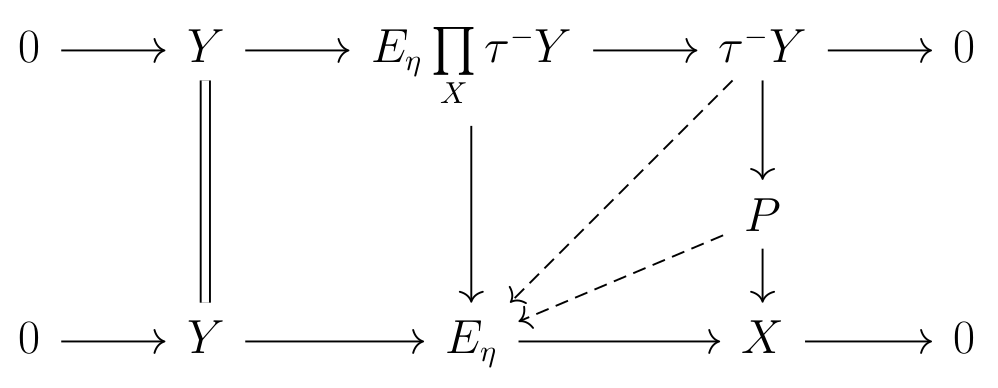
Since $P$ is projective we can lift the map $E_\eta \to X$ to $P$, and then by composing we get that $f$ factors through $E_\eta \to X$. This means we have a commutative square:
$$\begin{CD} \tau^-Y @= \tau^-Y\\ @VVV @VVV\\ E_\eta @>>> X \end{CD}$$
Then by the pullback property we get that the identity on $\tau^- Y$ factors trough $E_\eta \prod\limits_X \tau^- Y \to \tau^- Y$. So $\eta f$ is split and thus 0 in $\Ext_\L^1(\tau^- Y, Y)$.
Next we want to check that for any nonzero $\eta \in \Ext_\L^1(X, Y)$ there is an $f \in \underline{\Hom}(\tau^- Y, X)$ such that $\langle \eta, f\rangle \neq 0$. Let $\eta$ be
$$\begin{CD} 0 @>>> Y @>>> E_\eta @>>> X @>>> 0 \end{CD}$$
and let
$$\begin{CD} 0 @>>> Y @>>> E @>>> \tau^-Y @>>> 0 \end{CD}$$
be the almost split sequence $\alpha_{\tau^-Y}$. Then since $Y \to E_\eta$ isn’t split it factors through the almost split map $Y \to E$. Taking cokernels we get the diagram
$$\begin{CD} 0 @>>> Y @>>> E @>>> \tau^-Y @>>> 0\\ @VVV @VVV @VVV @VVV @VVV\\ 0 @>>> Y @>>> E_\eta @>>> X @>>> 0 \end{CD}$$
Thus there is a map $f:\tau^-Y \to X$ such that $\eta f = \alpha_{\tau^-Y}$, and we have that $\langle \eta, f \rangle = \mu(\eta f) = \mu(\alpha_{\tau^-Y}) \neq 0$.
For the other direction assume $f:\tau^-Y \to X$ is a map that does not factor through any projective. Let $P \to X$ be an epimorphism from a projective to $X$, and let $K$ be its kernel. If we take the pullback with $f$ we get an extension of $\tau^-Y$ and $K$
$$\begin{CD} 0 @>>> K @>>> P @>>> X @>>> 0\\ @AAA @| @AAA @AAfA @AAA\\ 0 @>>> K @>>> E_X @>>> \tau^-Y @>>> 0 \end{CD}$$
This extension cannot be split because if it was $f$ would factor though $P$, and since we assumed $f$ doesn’t factor through a projective this is impossible. So the extensions isn’t split in particular the map $E_X \to \tau^-Y$ is not split epi. This means that it factors through the almost split sequence. Thus there is a map $g:K\to Y$ giving us the folowing diagram
$$\begin{CD} 0 @>>> K @>>> P @>>> X @>>> 0\\ @AAA @| @AAA @AAfA @AAA\\ 0 @>>> K @>>> E_X @>>> \tau^-Y @>>> 0\\ @VVV @VVgV @VVV @| @VVV\\ 0 @>>> Y @>>> E @>>> \tau^-Y @>>> 0\\ \end{CD}$$
Interchanging the order of when we do pushout and pullback we get a diagram like
$$\begin{CD} 0 @>>> K @>>> P @>>> X @>>> 0\\ @VVV @VVgV @VVV @| @VVV\\ 0 @>>> Y @>>> Y \coprod\limits_K P @>>> X @>>> 0\\ @AAA @| @AAA @AAfA @AAA\\ 0 @>>> Y @>>> E @>>> \tau^-Y @>>> 0\\ \end{CD}$$
Calling the middle sequence $\eta$ we get that $\eta f = \alpha_{\tau^-Y}$ and thus $\langle \eta, f \rangle \neq 0$.
This shows that we have a perfect pairing $\langle -,- \rangle: \Ext_\L^1(X, Y) \times \underline{\Hom}(\tau^- Y, X) \to k$ which gives us an isomorphism $\underline{\Hom}(\tau^- Y, X) \cong D\Ext_\L^1(X, Y)$. It’s pretty straight forward to see that this isomorphism is functorial in $X$. To get something functorial in $Y$ aswell we just have to choose our functionals $\mu \in D\Ext_\L^1(\tau^- Y, Y)$ in a compatible way. This can be done, but I will not dwell on the details here.
The AR duality gives a nice way to compute $\Ext^1$. Especially in the case when $\L$ is hereditary, becuase then $\underline{\Hom}(Y, X) = \Hom(Y, X)$ whenever $Y$ has no projective summands. This is the basis for something called $\tau$-tilting theory, which is a generalization of tilting theory where we replace the condition $\Ext^1(T, T) = 0$ with $\Hom(T, \tau T) = 0$. That’s all I had to say for now.